edit: A new safe separated cycleway has just been proposed for Henderson Road, adding 28 new street trees. Head here to make a submission: https://www.cityofsydney.nsw.gov.au/proposed-works-maintenance/have-your-say-walking-cycling-improvements-south-eveleigh-waterloo-metro
Have you heard of the Southern Arterial Route in Sydney? I hadn’t either – but you won’t be able to unsee the scar through Ultimo, Chippendale, Redfern and Waterloo. Here’s a ~12,000-word Wikipedia article with 153 references – with page numbers, for every sentence – to bring you and your search engine up to speed: https://en.wikipedia.org/wiki/Southern_Arterial_Route?useskin=vector
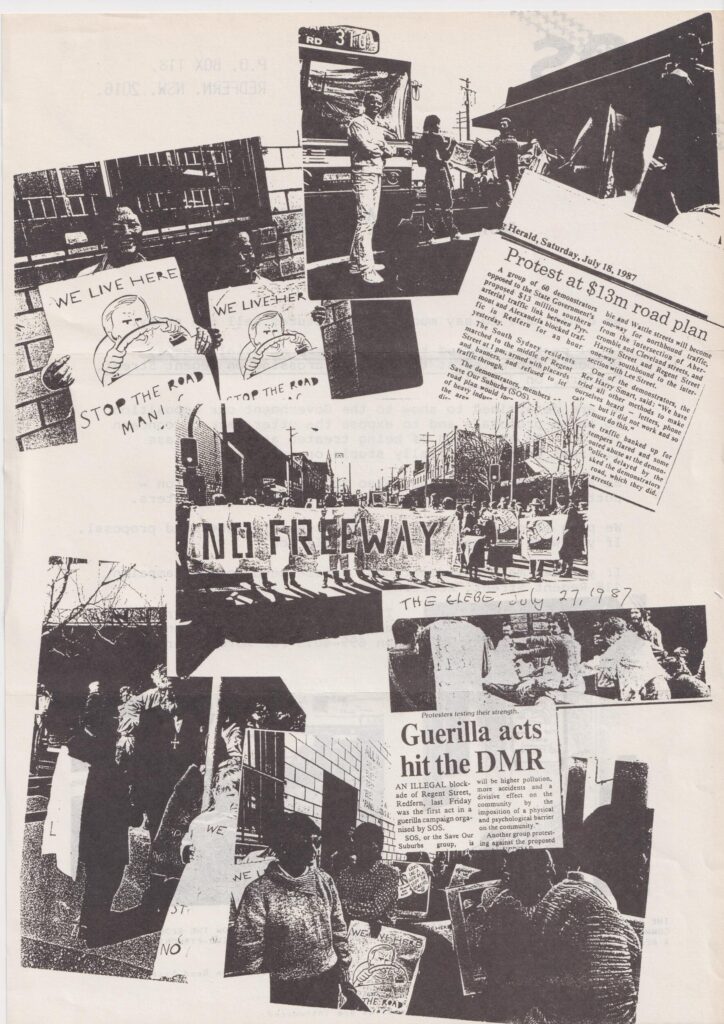
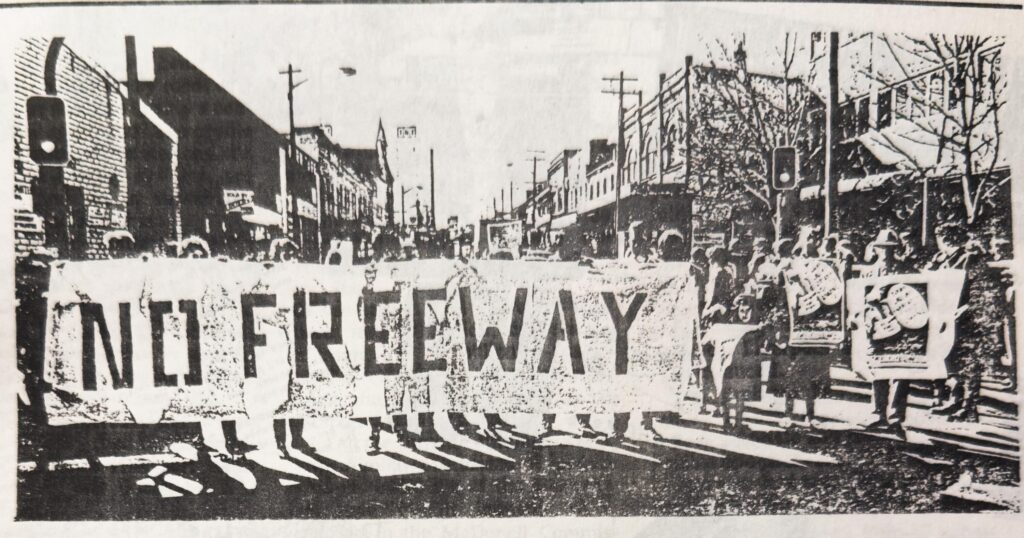
Only a few years after the Erskineville Uprising of 1985 there were substantial protests against this urban arterial road. Clover Moore opposed it in her 1988 campaign for the Bligh electorate and described it as a “Claytons freeway” – 38 years ago. 150 people attended a meeting to fight against it, and there were direct action protests after the opening, with 60 demonstrators in the street blocking Redfern traffic for an hour. “Guerilla acts hit the DMR” said the headlines. There were at least 36 Sydney Morning Herald articles on the development. It’s hard to oppose something if you don’t know the name of it.
After the partial opening in 1992 there was a “dramatic increase in traffic”. The traffic was so heavy residents’ walls cracked and caused structural damage to several homes. Noise interfered with conversations inside homes and disturbed sleep of residents. Crossing the street became difficult “in particular for children, the aged, disabled and mentally ill”. Residents moved out due to high lead levels in the blood of their daughter. The supermarket suffered a 30% decline. A resident was told their house value dropped by $50,000 in 1993 dollars (when the median Sydney house price was ~$188,000). The principal of the Alexandria Public School (Alexandria Park Community School) stated he was “not game” to have his pupils tested for lead levels in their blood – “if they’re high over in Balmain, there’s no way they aren’t going to be as high here”.
There were so many car crashes “Mike”, who lived on a busy corner of Wyndham, ran “a kind of unofficial St John’s Ambulance station from his house” – coming out to look after the victims lying on the road. He said “Since I’ve lived here I’ve lost 5 blankets.. and saved two lives.” – before a car crashed into his own house. Mike stated “They are crucifying the people who live here”.
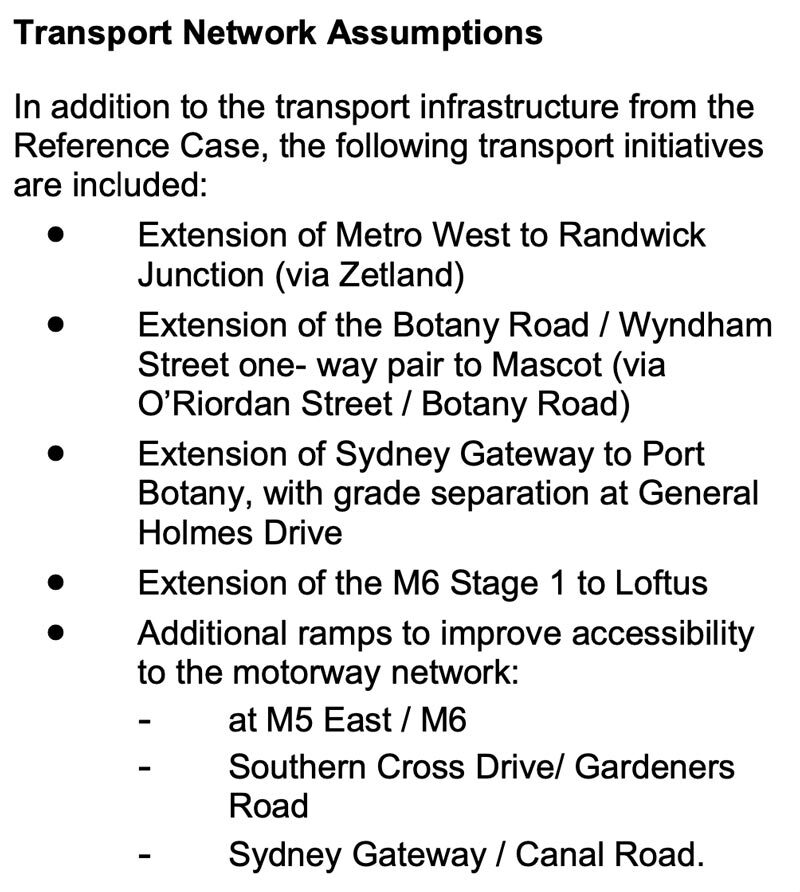
The Southern Arterial Route should not be extended (as assumed in Future Transport 2056). “if people count, Stage 3 of the Southern Arterial will not be built” (Citizen’s Report for proposed Stage 3, 1993). It should be at least partially reverted, per the 2021 Botany Road Corridor Urban Design Study (or perhaps even more ambitiously). The Citizen’s Report for the unbuilt stage 3 continued “on the same grounds, Stage 2 will be undone or significantly modified.”
Reviewers considered the draft neutrally written. In the spirit of Wikipedia, I hope you may agree the facts speak for themselves.
After two rounds of peer review through Wikipedia’s Articles for Creation review process (it was initially light on secondary references), my draft received a B-Class quality rating, placing in the top 4% of accepted articles. Personal compliments are not permitted on Wikipedia; review feedback included the article “…is, to say the least, very well documented”.
But now – this page is yours! If you spot any errors, notice something I missed, or find something I didn’t, hit that edit button! (you don’t need an account and your IP address isn’t even shown) It hopefully won’t remain only my writing for long. In the AI era, Wikipedia has never been more valuable. Thanks so much to the pseudo-anonymous editors who reviewed it and have made corrections.
This route threads the histories of the Green Bans and Wran’s 1977, Clover’s 1988 political campaign and the Darling Harbour opening that year, Anzac Bridge, the growth of Green Square and ongoing story of urban renewal in Waterloo.
Construction of the Southern Arterial potentially made traffic worse than doing nothing at all. The “Wyndham Street Residents’ Alternative” proposal, dismissed in the 1987 EIS but approximately matching the as-built design today, performs “significantly worse” (for cars) than if it was never implemented at all (according to the traffic modelling). The implementation of Stage 2 created such congestion that it drove people to support Stage 3 on the grounds that it would abolish the bottleneck at Henderson Road/Raglan Street/Wyndham Street. At this intersection it can be faster to catch the metro from Central to Waterloo than walk across this road, due to traffic signals timing. (Why Did the Chicken Catch the Metro? Because It Was Faster Than Crossing the Road…”, 2024)
More recently there have been proposals to partially revert the damage. Improvement seems politically or organisationally challenging – even the Redfern Waterloo Authority, created by “the most draconian and arrogant bill” Clover had ever seen and the “most draconian” agency she had encountered, was not able to wrestle the Roads & Traffic Authority to improve the street. The Citizen’s Advocate for the proposed Stage 3 claimed in 1993 that “some RTA personnel” have confidence that “not enough people care enough for there to be any danger of their plans not being realised.” I hope times have changed.
Keep the Southern Arterial in mind when you are late to uni and seemingly wait forever at the Broadway traffic lights, as you queue outside Radio Taco, as you risk your life crossing Cleveland Street mid-block amid missing crossings (or just give up visiting businesses on the other side), as you exit ABC’s headquarters looking up to the UTS pedestrian overpass, as you awkwardly balance on your bike waiting to cross from Mary Ann St to the Kelly Street cycleway, as you emerge from a carpark labyrinth in an uphill slog on Allen Street and face a (new) fence on Ultimo St, take a breather late at night on the Abercrombie Hotel balcony overlooking over that strange triangle island (perhaps during a dystopian city concept album), and when you pass the vacant shop fronts on Regent Street and Botany Road.
The proposal for this high-traffic, one-way pair urban vehicle arterial along urban shopping streets (a stroad) seems to have resurfaced every few years since at least 1969. It was resuscitated after the Wran government’s 1977 sell-off of road reservations put to rest terrifying plans to raze vast tracts of inner city housing to build surface expressways, Robert Moses-style. It appears the city council pushed for the arterial as an alternative to stave off these horrifying expressway plans (see 1974). As plans for road widening requiring “extensive property resumption” the council pushed a one-way scheme instead (1983). Eventually the DMR moved forward (1987) with such proposals, and there was opposition from a (perhaps transformed) council (1988).
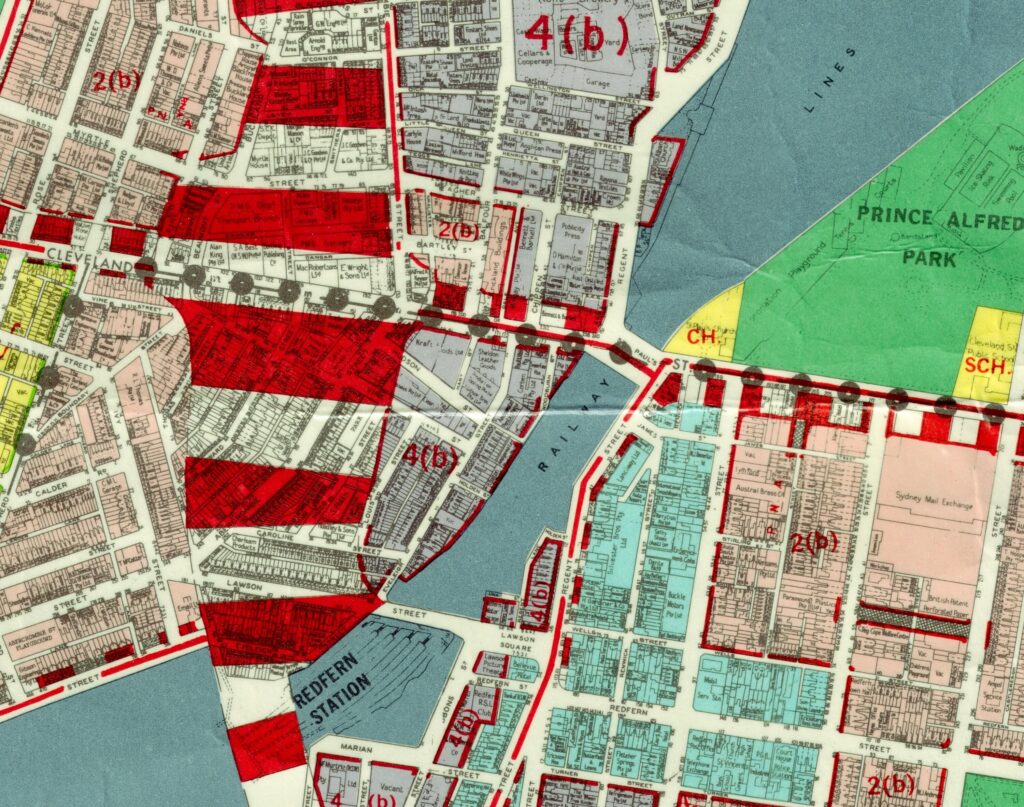
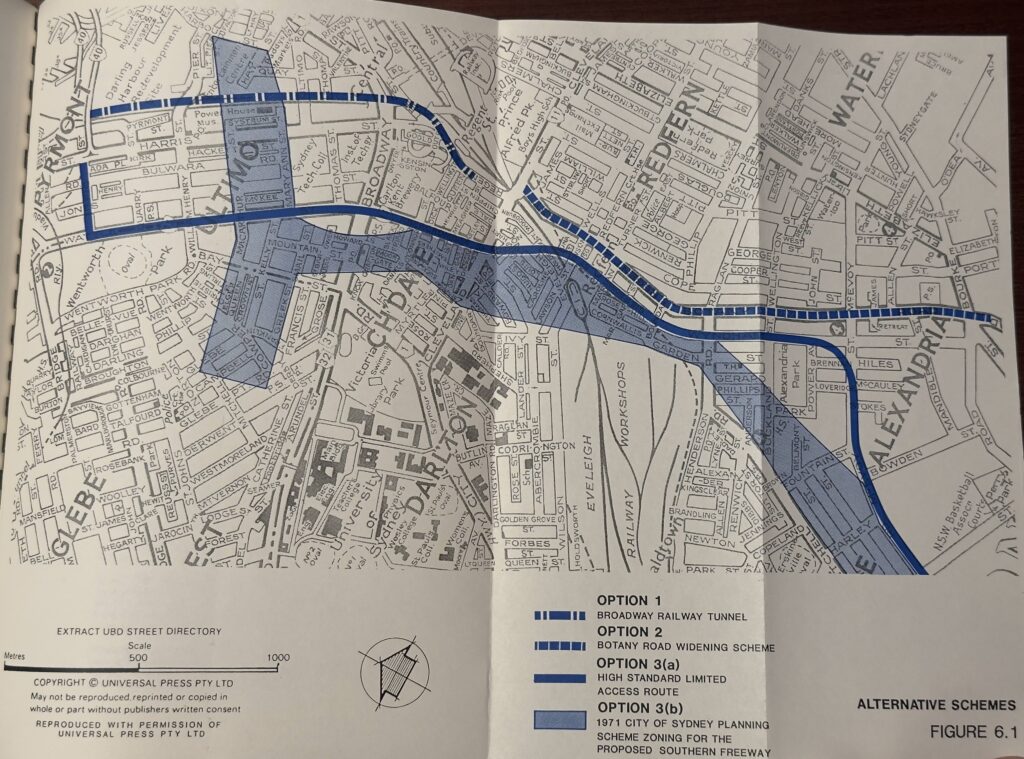
The Pyrmont-Alexandria Traffic Management Proposal Environmental Impact Statement (EIS) was approved in 1987 “amid controversy” (SMH), seemingly intentionally the least worst option against an alternate elevated expressway callously struck through the heart of Redfern (The Public Transport Option was dismissed as “Diversion of car drivers and passengers to the existing rail network is not considered likely”) and because “neither rail or bus public transport satisfies the objectives of the Proposal”.
The immensely unpopular project was never completed and seems to have lurked just under the surface in the state roads department ever since. The unstoppable force of road building met an immovable object in the 1990s recession (with the official reason being uncertainty of the M5 exit blocking traffic modelling for the EIS) – only to re-emerge in a 2003-2006 gasp for air (I don’t know what happened in 2006 – let me know or even better, edit the page).
Plans to expand this arterial perhaps still lurk in the deep. There are lukewarm public documents published within the last 6 years which assume extension of this urban high-vehicle-capacity arterial. The unbuilt Stage 3 extension of the Southern Arterial was predicted to cut average delays by only 12 seconds, from 24 to 12 seconds (and rising from 12 to 25 seconds by 2005). Such numbers remind me of the modelling to increase vehicle capacity at Epping Bridge, causing induced demand.
As recently as 2023 the state government removed a pedestrian crossing at Allen Street and Harris Street against their policy – to save motorists an estimated 8 seconds in the AM-peak (according to the modelling). In January 2025 even more slip lanes were added at Cleveland Street and Regent Street with unclear consultation, but in 1987 this wasn’t just an intersection: “A focus on city views” was emphasised on a drawing titled St. Paul’s Place. The polluted confluence of the Cleveland Street and Regent Street traffic sewers was a public square/place, but this non-place still has a name. This urban arterial has flown under the radar for far too long.
Wyndham Street residents – cling to your zebra crossings! The Southern Arterial does, after all, take in one of only two ‘unimproved’ surface AusRAP 2-star segments in the City of Sydney (the other one, City Road and Newtown’s King Street, will be a “traffic nirvana” any day now). History is not over.
On the sunny side, there are also proposals floating out there to partially revert the damage and turn the Regent Street stroad back into lively shopping street – and improve the amenity for the substantial density of new housing being constructed nearby. Further north, perhaps the long-overdue removal of the Wentworth Park greyhound track and new homes nearby will spur a rethink of Wattle Street. Currently this road cuts residents off from their hard-won parkland (so dangerous the adjacent school needs an overpass). Perhaps it’s time for road-space reallocation for buses (and active transport) with safer speed limits, now we have a parallel heavy rail, metro, a second airport, no more Port Jackson freight, and of course – WestConnex.
The least we owe the residents of Redfern and Waterloo is to improve the safety and amenity of this street.
You might like to check out the Sydney Morning Herald Archives site. For a very reasonable fee you get time-limited search access to some fascinating history, and the results are still accessible for free afterwards. The (newly renovated) State Library is a wonderful place – I’d like to spend more time there. I’ve learned a lot about Sydney’s planning and transport history and why things are the way they are. I was originally going to publish this last year, but terrible events occurred so I postponed.
Wikipedia is wonderful – it’s like OpenStreetMap but an encyclopaedia.
https://en.wikipedia.org/wiki/Southern_Arterial_Route?useskin=vector
After four weeks of talking to people and reviewing the evidence, my chief
conclusion is simply this: if people count, Stage 3 of the Southern Arterial will not be built. Further, on the same grounds, Stage 2 will be undone or significantly modified.This inclusion of Stage 2 is important for the reason that abandonment of Stage 3 alone will not solve the traffic problems in this area. The implementation of Stage 2 to the Henderson Road/Raglan Street intersection has, for example, created such ugly congestion, especially in Wyndham Street, that it drives people to supporting Stage 3 on the grounds that it will at least abolish this awful bottleneck. Stage 3 (in its unimplemented form) can appear as the lesser of two evils. Ideally we need a solution to the problems of Stage 2 which does not involve the evils of Stage 3.
Hall Greenland (1993-06-30). “Citizen’s Response to the proposed Stage 3 of the Southern Arterial (Citizen’s Advocate Report)”.
Leave a Reply